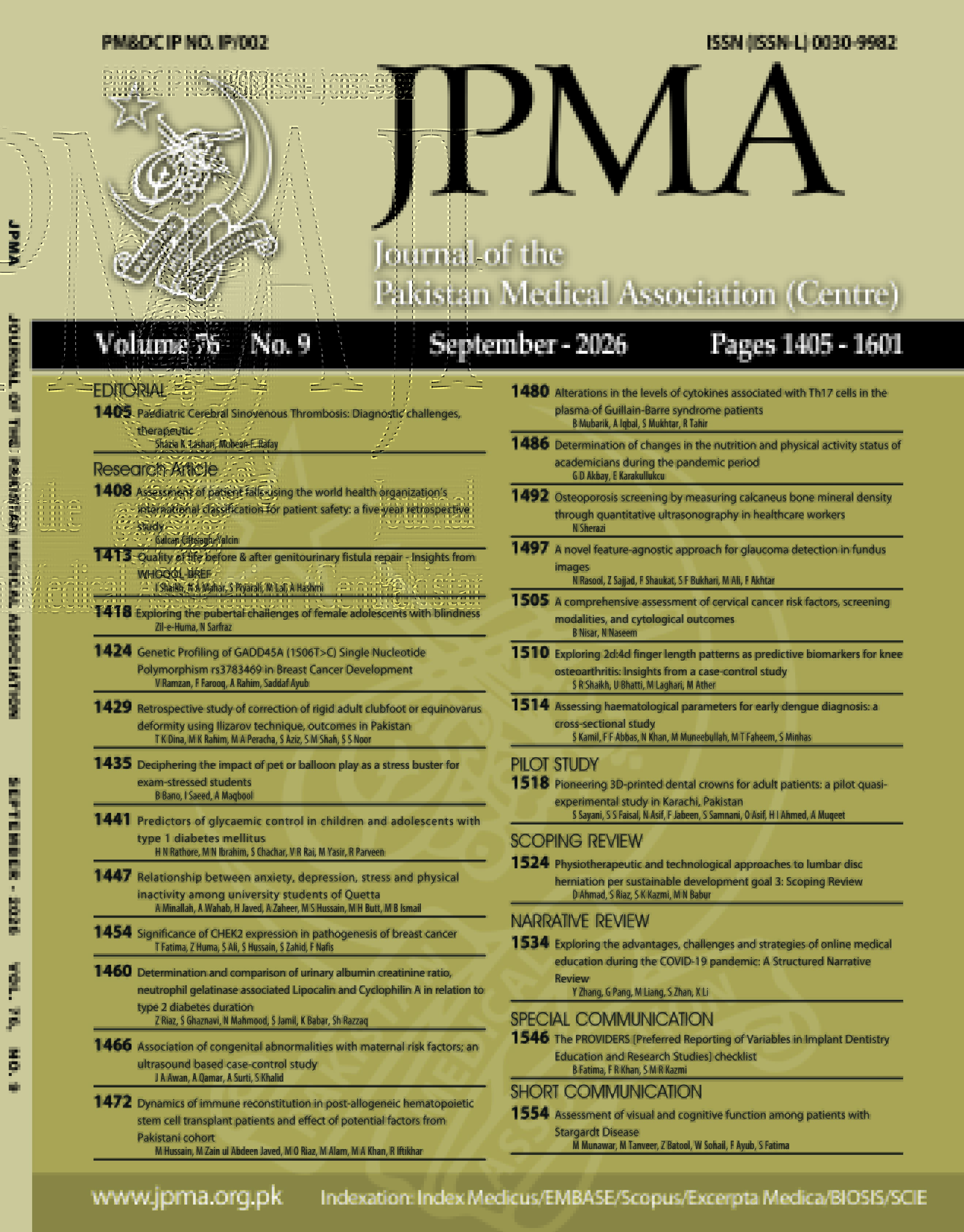
Relationship between anxiety, depression, stress and physical inactivity among university students of Quetta
DOI:
https://doi.org/10.47391/JPMA.30414Keywords:
Anxiety, Depression, Stress, Sedentary behaviour, ExerciseAbstract
Objective: To find the frequency of depression, anxiety and stress among university students, and to ascertain the condition’s association with physical inactivity.
Method: The cross-sectional, analytical study was conducted from November 2023 to May 2024 at the Quetta Institute of Medical Sciences, Quetta, Pakistan, and comprised students belonging to three universities. Data was collected using a predesigned questionnaire that also included the International Physical Activity Questionnaire to check physical inactivity and the Depression Anxiety Stress Scale to assess depression, anxiety and stress levels. Data was analysed using SPSS 25.
Results: Of the 400 participants, with a mean age of 22 years (±3.89years), 233(58.25%) were male, 167(41.75%) were female, 286(71.5%) were studying medicine, and 114(28.5%) were enrolled in non-medical degrees. Physical inactivity was significantly associated with anxiety, depression and stress (p=0.001). Female students reported lower activity and higher rates of anxiety, depression and stress. Nuclear families tended to have better mental health, while joint families showed more extreme cases of anxiety and depression. The nature of the degree in which a student was enrolled had no significant association. A similar result was observed for residence (rural or urban).
Conclusion: Physical inactivity was found to be significantly associated with anxiety, depression and stress, indicating the need for a prompt targeted intervention.
Key Words: Anxiety, Depression, Stress, Sedentary behaviour, Exercise.
Downloads
Published
How to Cite
Issue
Section
License
Copyright (c) 2026 Journal of the Pakistan Medical Association

This work is licensed under a Creative Commons Attribution 4.0 International License.


